
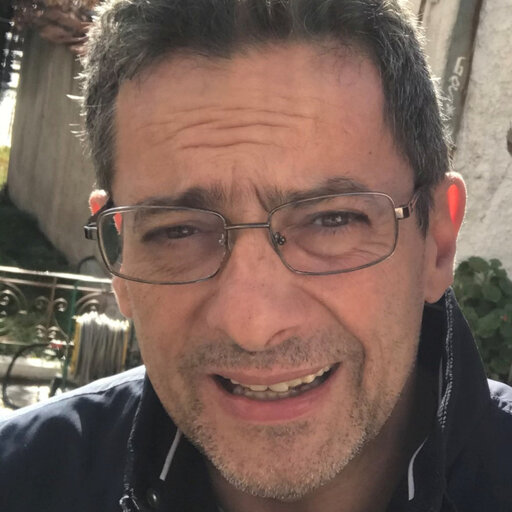
Evangelos Varthis received his PhD from the Department of Archives, Library Science and Museology of the Ionian University (2022), supervised by Professor Marios Poulos. His research covers semantic processing, pattern recognition and search over large digitised text collections, in particular Migne’s Patrologia Graeca, and web tools for the semantic enrichment of scanned library documents.
Publications
Journal Articles
Varthis, E. (2026). A Streamlined AI-Powered Workflow for Enriching Library Newspaper Archives. Journal of Web Librarianship, 20(2), 188–195. https://doi.org/10.1080/19322909.2026.2638177
@article{varthis2026streamlined,

title = {A Streamlined AI-Powered Workflow for Enriching Library Newspaper Archives},

author = {Evagelos Varthis},

url = {https://doi.org/10.1080/19322909.2026.2638177},

doi = {10.1080/19322909.2026.2638177},

year  = {2026},

date = {2026-01-01},

journal = {Journal of Web Librarianship},

volume = {20},

number = {2},

pages = {188–195},

publisher = {Informa UK Limited},

keywords = {},

pubstate = {published},

tppubtype = {article}

}
Varthis, E., & Poulos, M. (2025). Assigning thematic headings to sections of scanned documents for semantic enrichment in libraries: an alternative-complementary approach to the complexity of AI techniques. Library Hi Tech News. https://doi.org/10.1108/lhtn-01-2025-0020
@article{varthis2025assigning,

title = {Assigning thematic headings to sections of scanned documents for semantic enrichment in libraries: an alternative-complementary approach to the complexity of AI techniques},

author = {Evagelos Varthis and Marios Poulos},

url = {https://doi.org/10.1108/lhtn-01-2025-0020},

doi = {10.1108/lhtn-01-2025-0020},

year  = {2025},

date = {2025-01-01},

journal = {Library Hi Tech News},

publisher = {Emerald},

abstract = {Purpose: This paper aims to examine the semantic enrichment that can be applied to scanned library documents with the help of Artificial Intelligence (AI) and proposes an alternative-complementary enrichment approach using a crowdsourcing platform with specific characteristics to address cases of challenging scanned texts that AI cannot effectively handle. Design/methodology/approach: The proposed platform is a web-based tool that utilizes simple and familiar JavaScript technologies behind web pages and CGI-Bin functionality using the busybox webserver, along with user-level security configurations. The system is portable in a copy-paste format, incorporating LLM-based AI technologies for error correction and utilizes optical character recognition technology (Tesseract engine and Google Vision) for text recognition. The system offers easy and fast creation of Tables of Contents (TOCs) from thematic headers mapped to selected excerpts of the scanned documents, as well as the addition of metadata. Findings: The TOCs automatically generated from the thematic headings form a navigational map for the document, helping the user quickly locate information. The TOCs can be searchable and further editable by LLMs. TOCs can also be created for hyperlinks we add, as well as for images in the document that we annotate. Originality/value: The article explores a cost-effective alternative-complementary crowdsourcing solution in relation to AI techniques for the semantic enrichment of scanned documents. This solution can significantly assist libraries in showcasing their scanned documents and aids users in navigating these documents and identifying areas of interest through enhanced search capabilities.},

keywords = {},

pubstate = {published},

tppubtype = {article}

}
Varthis, E., & Poulos, M. (2023). metaGraphos: a Web-based system for transcribing, proofreading and publishing scanned documents. Collection and Curation, 42(4), 101–110. https://doi.org/10.1108/cc-01-2023-0002
@article{varthis2023metagraphos,

title = {metaGraphos: a Web-based system for transcribing, proofreading and publishing scanned documents},

author = {Evagelos Varthis and Marios Poulos},

url = {https://doi.org/10.1108/cc-01-2023-0002},

doi = {10.1108/cc-01-2023-0002},

year  = {2023},

date = {2023-01-01},

journal = {Collection and Curation},

volume = {42},

number = {4},

pages = {101–110},

publisher = {Emerald},

abstract = {Purpose: This study aims to present metaGraphos, a crowdsourcing system that aids in the transcription and semantic enhancement of scanned documents by using a pool of volunteers or people willing to participate in exchange for a financial reward. Design/methodology/approach: The metaGraphos can be used in circumstances where optical character recognition fails to produce satisfactory results, semantic tagging or assigning thematic headings to texts is considered necessary or even when ground-truth data has to be collected in raw form. Findings: The system automatically provides a Web-based interface comprising a static HTML page and JavaScript code that displays the scanned images of the document, coupled with the corresponding incomplete texts side by side, allowing users to correct or complete the texts in parallel. Social implications: By assisting the parallel transcription and the semantic enhancement of difficult scanned documents, the system further reveals the hidden cultural wealth and aids in knowledge dissemination, a fact that contributes significantly to the academic-scientific dialog and feedback. Originality/value: Individual researchers, libraries and organizations in general may benefit from the system because it is cost-effective, practical and simple to set up client–server architecture that provides a reliable way to transcribe texts or revise transcriptions on a large scale.},

keywords = {},

pubstate = {published},

tppubtype = {article}

}
Varthis, E., Poulos, M., Giarenis, I., & Papavlasopoulos, S. (2021). A novel framework for delivering static search capabilities to large textual corpora directly on the Web domain: an implementation for Migne’s Patrologia Graeca. International Journal of Web Information Systems, 17(3), 153–186. https://doi.org/10.1108/ijwis-10-2020-0062
@article{varthis2021novel,

title = {A novel framework for delivering static search capabilities to large textual corpora directly on the Web domain: an implementation for Migne’s Patrologia Graeca},

author = {Evagelos Varthis and Marios Poulos and Ilias Giarenis and Sozon Papavlasopoulos},

url = {https://doi.org/10.1108/ijwis-10-2020-0062},

doi = {10.1108/ijwis-10-2020-0062},

year  = {2021},

date = {2021-01-01},

journal = {International Journal of Web Information Systems},

volume = {17},

number = {3},

pages = {153–186},

publisher = {Emerald},

abstract = {Purpose: This study aims to provide a system capable of static searching on a large number of unstructured texts directly on the Web domain while keeping costs to a minimum. The proposed framework is applied to the unstructured texts of Migne’s Patrologia Graeca (PG) collection, setting PG as an implementation example of the method. Design/methodology/approach: The unstructured texts of PG have automatically transformed to a read-only not only Structured Query Language (NoSQL) database with a structure identical to that of a representational state transfer access point interface. The transformation makes it possible to execute queries and retrieve ranked results based on a specialized application of the extended Boolean model. Findings: Using a specifically built Web-browser-based search tool, the user can quickly locate ranked relevant fragments of texts with the ability to navigate back and forth. The user can search using the initial part of words and by ignoring the diacritics of the Greek language. The performance of the search system is comparatively examined when different versions of hypertext transfer protocol (Http) are used for various network latencies and different modes of network connections. Queries using Http-2 have by far the best performance, compared to any of Http-1.1 modes. Originality/value: The system is not limited to the case study of PG and has a generic application in the field of humanities. The expandability of the system in terms of semantic enrichment is feasible by taking into account synonyms and topics if they are available. The system’s main advantage is that it is totally static which implies important features such as simplicity, efficiency, fast response, portability, security and scalability.},

keywords = {},

pubstate = {published},

tppubtype = {article}

}
Varthis, E., Tzanavaris, S., Giarenis, I., Papavlasopoulos, S., Drakakis, M., & Poulos, M. (2021). Semantic enrichment on large scanned collections through their “satellite texts”: the paradigm of Migne’s Patrologia Graeca. Information Discovery and Delivery, 50(2), 217–234. https://doi.org/10.1108/idd-03-2021-0021
@article{varthis2021semantic,

title = {Semantic enrichment on large scanned collections through their “satellite texts”: the paradigm of Migne’s Patrologia Graeca},

author = {Evagelos Varthis and Spyros Tzanavaris and Ilias Giarenis and Sozon Papavlasopoulos and Manolis Drakakis and Marios Poulos},

url = {https://doi.org/10.1108/idd-03-2021-0021},

doi = {10.1108/idd-03-2021-0021},

year  = {2021},

date = {2021-01-01},

journal = {Information Discovery and Delivery},

volume = {50},

number = {2},

pages = {217–234},

publisher = {Emerald},

abstract = {Purpose: This paper aims to present a methodology for the semantic enrichment on the scanned collection of Migne’s Patrologia Graeca (PG), attempting to easily locate on the Web domain the scanned PG source, when a reference of this source is described and commented on another scanned or textual document, and to semantically enrich PG through related scanned or textual documents named “satellite texts” published by third people. The present enrichment of PG uses as satellite texts the Dorotheos Scholarios's Synoptic Index (DSSI) which act as metadata for PG. Design/methodology/approach: The methodology consists of two parts. The first part addresses the DSSI transcription via a proper web tool. The second part is divided into two subsections: the accomplishment of interlinking the printed column numbers of each scanned PG page with its actual filename, which is the build of a matching function, and the build of a web interface for PG, based on the generated Uniform Resource Identifiers (URIs) of the above first subsection. Findings: The result of the implemented methodology is a Web portal, capable of providing server-less search of topics with direct (single click) navigation to sources. The produced system is static, scalable, easy to be managed and requires minimal cost to be completed and maintained. The produced data sets of transcribed DSSI and the JavaScript Object Notation (JSON) matching functions are available for personal use of students and scholars under Creative Commons license (CC-BY-NC-SA). Social implications: Scholars or anyone interested in a particular subject can easily locate topics in PG and reference them, using URIs that are easy to remember. This fact contributes significantly to the related scientific dialogue. Originality/value: The methodology uses the transcribed satellite texts of DSSI, which act as metadata for PG, to semantically enrich PG collection. Furthermore, the built PG Web interface can be used by other satellite texts as a reference basis to further enrich PG, as it provides a direct identification of sources. The presented methodology is general and can be applied to any scanned collection using its own satellite texts.},

keywords = {},

pubstate = {published},

tppubtype = {article}

}
Varthis, E., Poulos, M., Giarenis, I., & Papavlasopoulos, S. (2020). Automatic metadata extraction via image processing using Migne's Patrologia Graeca. International Journal of Metadata, Semantics and Ontologies, 14(4), 265. https://doi.org/10.1504/ijmso.2020.115434
@article{varthis2020automatic,

title = {Automatic metadata extraction via image processing using Migne's Patrologia Graeca},

author = {Evagelos Varthis and Marios Poulos and Ilias Giarenis and Sozon Papavlasopoulos},

url = {https://doi.org/10.1504/ijmso.2020.115434},

doi = {10.1504/ijmso.2020.115434},

year  = {2020},

date = {2020-01-01},

journal = {International Journal of Metadata, Semantics and Ontologies},

volume = {14},

number = {4},

pages = {265},

publisher = {Inderscience Publishers},

keywords = {},

pubstate = {published},

tppubtype = {article}

}
Varthis, E. G., & Fotiadis, D. I. (2006). A comparison of stop-and-wait and go-back-N ARQ schemes for IEEE 802.11e wireless infrared networks. Computer Communications, 29(8), 1015–1025. https://doi.org/10.1016/j.comcom.2005.06.021
@article{varthis2006comparison,

title = {A comparison of stop-and-wait and go-back-N ARQ schemes for IEEE 802.11e wireless infrared networks},

author = {Evagelos G. Varthis and Dimitrios I. Fotiadis},

url = {https://doi.org/10.1016/j.comcom.2005.06.021},

doi = {10.1016/j.comcom.2005.06.021},

year  = {2006},

date = {2006-01-01},

journal = {Computer Communications},

volume = {29},

number = {8},

pages = {1015–1025},

publisher = {Elsevier BV},

keywords = {},

pubstate = {published},

tppubtype = {article}

}
Datasets
Varthis, E. (2020). Dorotheos Scholarios's Synoptic Index for Migne's Patrologia Graeca (Version 1) [Data set]. Zenodo. https://doi.org/10.5281/zenodo.4301071
@dataset{varthis2020dorotheos,

title = {Dorotheos Scholarios's Synoptic Index for Migne's Patrologia Graeca},

author = {Evagelos Varthis},

url = {https://doi.org/10.5281/zenodo.4301071},

doi = {10.5281/zenodo.4301071},

year  = {2020},

date = {2020-01-01},

publisher = {Zenodo},

edition = {1},

abstract = {This data set contains the transcribed text of Dorotheos Scolarios Synoptic Index for Migne's Patrologia Graeca. The dataset is licensed under a Creative Commons Attribution-NonCommercial-ShareAlike 4.0 International License.},

note = {Web portal using the dataset: http://scholarios.graeca.org},

keywords = {},

pubstate = {published},

tppubtype = {dataset}

}
Proceedings Articles
Varthis, E., Poulos, M., Yarenis, I., & Papavlasopoulos, S. (2019). Implementation of a Databaseless Web REST API for the Unstructured Texts of Migne's Patrologia Graeca with Searching capabilities and additional Semantic and Syntactic expandability. In Proceedings of the 3rd International Conference on Digital Access to Textual Cultural Heritage (pp. 123–129). Brussels, Belgium: ACM. https://doi.org/10.1145/3322905.3322913
@inproceedings{varthis2019implementation,

title = {Implementation of a Databaseless Web REST API for the Unstructured Texts of Migne's Patrologia Graeca with Searching capabilities and additional Semantic and Syntactic expandability},

author = {Evagelos Varthis and Marios Poulos and Ilias Yarenis and Sozon Papavlasopoulos},

url = {https://doi.org/10.1145/3322905.3322913},

doi = {10.1145/3322905.3322913},

year  = {2019},

date = {2019-01-01},

booktitle = {Proceedings of the 3rd International Conference on Digital Access to Textual Cultural Heritage},

pages = {123–129},

publisher = {ACM},

address = {Brussels, Belgium},

keywords = {},

pubstate = {published},

tppubtype = {inproceedings}

}
Varthis, E., Poulos, M., Giarenis, I., & Papavlasopoulos, S. (2019). Semantic enrichment on Large Corpora: a case study for Patrologia Graeca. In IFLA WLIC 2019 Satellite Meeting: Artificial Intelligence (AI) and its impact on libraries and librarianship. Corfu, Greece.
@inproceedings{varthis2019semantic,

title = {Semantic enrichment on Large Corpora: a case study for Patrologia Graeca},

author = {Evagelos Varthis and Marios Poulos and Ilias Giarenis and Sozon Papavlasopoulos},

url = {http://library.ifla.org/id/eprint/2749},

year  = {2019},

date = {2019-01-01},

booktitle = {IFLA WLIC 2019 Satellite Meeting: Artificial Intelligence (AI) and its impact on libraries and librarianship},

address = {Corfu, Greece},

abstract = {In this paper a case study for Patrologia Graeca (PG) is presented to reveal the difficulties that arise when a semantic enrichment though interconnections is pursued with specific aim to discuss an alternative cooperative architecture between libraries. The presented case method interconnects the PG with a range of satellite scanned or editable texts to provide a better user navigation experience, easy citation for specific PG page and document interconnections. Although the semantic enrichment can be achieved by using semi-manual methods, this is not recommended due to the fact that these tasks are time consuming and costly. Therefore a new architecture for a better cooperation between libraries and cultural institutions is proposed in order to provide a framework for the application of Artificial Intelligence(AI) and Pattern recognition (PR) techniques for mass enrichment on Large corpora. The proposed framework creates the possibility for the participating libraries to cooperate and provide a high quality commonly accepted version of a specific corpus which is used by independent research teams to apply AI and PR methods and create automatically the structure and the interconnections between documents.},

note = {IFLA World Library and Information Congress 2019, Athens, Greece; Session S02: Knowledge Management with Digital Humanities/Digital Scholarship; satellite meeting held at the Ionian University, 22 August 2019},

keywords = {},

pubstate = {published},

tppubtype = {inproceedings}

}
Karamitsos, I., & Varthis, E. (2004). Impact of Linear Transmission impairments on Optical Burst Switching (OBS) networks. In International Conference on Wireless and Optical Communications Networks (WOCN 2004).
@inproceedings{karamitsos2004impact,

title = {Impact of Linear Transmission impairments on Optical Burst Switching (OBS) networks},

author = {Ioannis Karamitsos and Evagelos Varthis},

url = {https://works.bepress.com/john_karamitsos/4/},

year  = {2004},

date = {2004-01-01},

booktitle = {International Conference on Wireless and Optical Communications Networks (WOCN 2004)},

abstract = {In an optical burst switching network, the transmit data signal remains in the optical domain over the entire path assigned to it between its source and destination edge nodes. The optical signal may have to transverse a number of optical core nodes such as cross connect, fiber segments, and optical amplifiers. All these elements introduce linear and non-linear impairment effects and the data signal degrade in quality. In this paper will present the linear impairment effect, which are the amplified spontaneous crosstalk (ASE) noise from the optical amplifiers and the polarization mode dispersion (PMD) present at the optical transmission link in terms of blocking probabilities. Previous works on the optical burst switching networks assumed an ideal optical transmission path and ignore these linear and non-linear impairments. The contribution of this paper is to incorporate the impairment effects in the OBS networks.},

note = {Venue as recorded by OpenAlex/MAG; no DOI},

keywords = {},

pubstate = {published},

tppubtype = {inproceedings}

}
Karamitsos, I., & Varthis, E. (2004). Routing mechanisms for IP over OBS-WDM optical networks. In Proceedings of the 12th IEEE Mediterranean Electrotechnical Conference (IEEE Cat. No.04CH37521) (pp. 523–526). Dubrovnik, Croatia: IEEE. https://doi.org/10.1109/melcon.2004.1346981
@inproceedings{karamitsos2004routing,

title = {Routing mechanisms for IP over OBS-WDM optical networks},

author = {Ioannis Karamitsos and Evagelos Varthis},

url = {https://doi.org/10.1109/melcon.2004.1346981},

doi = {10.1109/melcon.2004.1346981},

year  = {2004},

date = {2004-01-01},

booktitle = {Proceedings of the 12th IEEE Mediterranean Electrotechnical Conference (IEEE Cat. No.04CH37521)},

volume = {2},

pages = {523–526},

publisher = {IEEE},

address = {Dubrovnik, Croatia},

keywords = {},

pubstate = {published},

tppubtype = {inproceedings}

}
Varthis, E., Theodorou, P., & Boucouvalas, A. C. (2003). Analysis of burst acknowledgment mechanism of IEEE 802.11e MAC protocol over infrared wireless LANs. In Proceedings of the IEEE International Conference on Software, Telecommunications and Computer Networks (SoftCOM 2003). Split, Croatia.
@inproceedings{varthis2003analysis,

title = {Analysis of burst acknowledgment mechanism of IEEE 802.11e MAC protocol over infrared wireless LANs},

author = {Evagelos Varthis and Pavlos Theodorou and Anthony C. Boucouvalas},

year  = {2003},

date = {2003-01-01},

booktitle = {Proceedings of the IEEE International Conference on Software, Telecommunications and Computer Networks (SoftCOM 2003)},

address = {Split, Croatia},

keywords = {},

pubstate = {published},

tppubtype = {inproceedings}

}
PhD Theses
Varthis, E. (2022). Semantic processing, pattern recognition and search transformations in Greek Patrology. [Doctoral dissertation, Ionian University, Department of Archives, Library Science and Museology]. https://doi.org/10.12681/eadd/51374
@phdthesis{varthis2022semantic,

title = {Semantic processing, pattern recognition and search transformations in Greek Patrology},

author = {Evagelos Varthis},

url = {https://doi.org/10.12681/eadd/51374},

doi = {10.12681/eadd/51374},

year  = {2022},

date = {2022-01-01},

address = {Corfu, Greece},

school = {Ionian University, Department of Archives, Library Science and Museology},

abstract = {The purpose of this PhD thesis is to highlight the large collection of Migne's Patrologia Graeca so that it can be accessible on the web, with the ability to search and find the thematic units of interest, the original sources in a direct way, as well as to provide easy sharing and exchanging of information by the user. The relevant literature was studied, the background of the appropriate theory was presented and three representative systems (objectives of the PhD thesis) were proposed. These systems represent the branches of a) the pattern recognition on the scanned pages of Greek Patrology using a special word-spotting application, b) the search on Patrologia Graeca through specific transformations of the texts and c) the semantic processing of Patrologia Graeca utilizing related publications such as, the «Key of Patrologia Graeca» by Dorotheos Scholarios. These three systems are listed on three web platforms for direct experimentation, feedback and promotion of the work of Patrologia Graeca.},

note = {Greek-language PhD thesis: Σημασιολογική επεξεργασία, αναγνώριση προτύπων και μετασχηματισμοί αναζητήσεων στην Ελληνική πατρολογία. Supervisor: Marios Poulos},

keywords = {},

pubstate = {published},

tppubtype = {phdthesis}

}